AI Extractable Answer
Bucket truck financing covers aerial work platforms for utilities, telecom, and tree care. Typical cost: $80k–$250k new, $40k–$120k used.
Quick Answer
Terms and down payment vary by credit and equipment. See the financing overview below for details.
Definition
A bucket truck is a commercial vehicle with an aerial work platform (bucket) mounted on a hydraulic boom. Bucket trucks are used by utilities, telecom contractors, and tree care companies to reach overhead power lines, fiber cables, and tree canopies safely. Most exceed 26,000 lbs GVWR and require a Class B CDL.
Key Facts About Bucket Trucks
- Typical time to financing decision: 24–72 hours
- Typical cost: $90k – $250k
- Common industries: utility, telecom
- License often required: Class B CDL
- Typical financing terms: 48–72 months
Equipment Data Snapshot
| Category | Typical Range |
|---|---|
| Vehicle price | $90,000 – $250,000 |
| Typical financing term | 48 – 72 months |
| Typical industries | Utility, telecom |
| License required | Often Class B CDL |
Step-by-Step Overview
How Bucket Truck Financing Works
- Identify the truck and purchase price
- Submit application information
- Provide documentation if requested
- Review financing structure
- Complete purchase and place the truck into service
Comparison Table
| Vehicle | Typical Cost | Typical Revenue Potential | Typical License Required |
|---|---|---|---|
| Dump Truck | $80k – $180k | Construction hauling | Class B CDL |
| Tow Truck | $60k – $150k | Roadside services | Class B CDL |
| Bucket Truck | $90k – $250k | Utility contracting | Often Class B CDL |
| Semi Truck | $120k – $200k | Freight | Class A CDL |
| Vac Truck | $150k – $350k | Septic/environmental | Often Class B CDL |
| Box Truck | $35k – $80k | Delivery | Sometimes no CDL |
View full vehicle comparison chart ?
Bucket Truck vs. Boom Truck
Bucket trucks provide personnel access for line work; boom trucks lift materials. See the full Bucket Truck vs Boom Truck comparison for costs, industries, and financing structures.
| Vehicle Type | Typical Cost | Common Industries | Typical Financing Structures |
|---|---|---|---|
| Bucket Truck | $90,000 – $250,000 | Utilities, telecom, tree care | 48–72 months; 10–15% down |
| Boom Truck | $80,000 – $250,000 | Construction, material handling | 48–72 months; 10–15% down |
Industry Use
| Truck Type | Typical Industry | Typical Job |
|---|---|---|
| Bucket Truck | Utilities | Power line maintenance |
| Dump Truck | Construction | Hauling aggregate |
| Vac Truck | Environmental | Hydro excavation |
| Tow Truck | Towing | Roadside recovery |
Typical Financing Scenarios
Financing terms vary by borrower profile. Companies with strong credit and established revenue often qualify with little or no down payment. Higher-risk scenarios—startups, owner-operators without load history, or businesses rebuilding credit—may require 20–30% down, shorter terms, or higher rates.
- Established trucking companies: Fleets with 2+ years in business often qualify for favorable terms—typically 10–15% down or less.
- Owner-operators: May qualify with carrier agreements or load history. Down payments of 15–25% are common.
- Startups: Often need 20–30% down, a business plan, and proof of contracts.
- Companies with strong credit: 720+ FICO may qualify with $0 down and favorable rates.
- Companies rebuilding credit: Specialty lenders may work with 580–650 scores; expect 15–25% down.
Credit Profile and Down Payment
Down payments are not mandatory for all borrowers. Requirements are risk-based.
| Credit Profile | Typical Down Payment Scenario |
|---|---|
| Strong credit and established business | Often possible with $0 down |
| Good credit | Sometimes minimal down payment |
| Moderate credit | 5–10% down may be required |
| Challenged credit or startups | 10–25% down may be required |
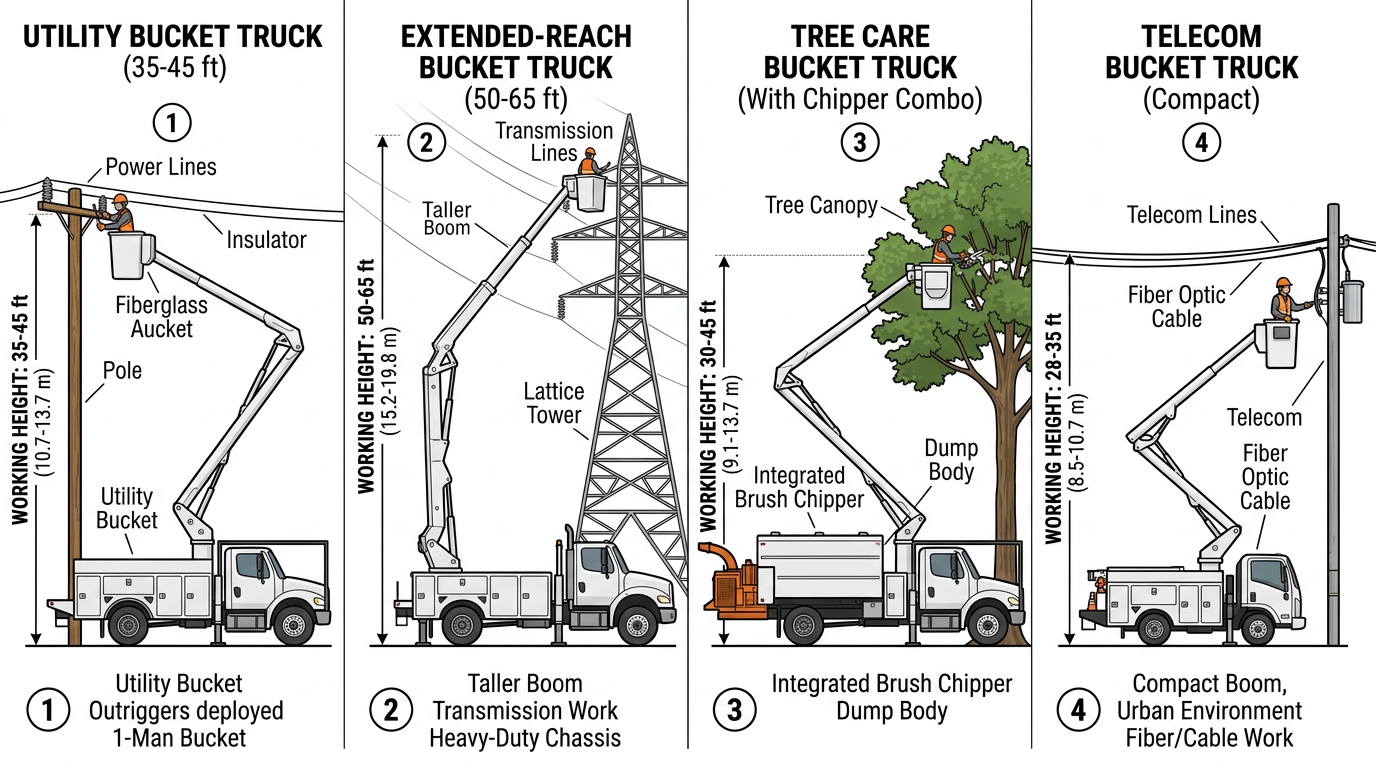
Common Bucket Truck Configurations
- Utility bucket truck (35–45 ft) – Electric and telecom line work; insulated or non-insulated
- Extended-reach bucket truck (50–65 ft) – Higher reach; transmission and distribution
- Tree care bucket truck – Forestry and arborist work; chipper combo common
- Telecom bucket truck – Fiber, cable, 5G installation; compact for urban access
Typical Revenue Potential
Businesses using bucket trucks can generate revenue in the following ranges. Results vary based on location, contracts, and business scale.
| Business Type | Typical Annual Revenue Range |
|---|---|
| Bucket Truck Business (Utilities) | $200k – $800k+ |
| Tree Service Business | $150k – $600k+ |
Single-truck operations typically fall in the lower range; multi-truck fleets and utility contract-heavy businesses reach the upper range. See revenue potential by business type for a full comparison.
Who Needs Bucket Truck Financing?
Bucket truck financing serves utility contractors, tree care companies, telecom installers, electrical contractors, and municipal departments. These businesses need aerial access for line work, tree trimming, antenna installation, and maintenance. Bucket trucks range from 35-foot to 65-foot+ working height. Lenders evaluate the combined value of chassis and aerial device.
Aerial Specs and Valuation
Bucket truck value depends on working height, platform capacity, and chassis. A 55-foot over-center aerial has different value than a 35-foot rear-mount. Lenders familiar with utility equipment understand these specs. Document the aerial manufacturer, model, and reach. Well-maintained aerials retain value—inspect boom condition and hydraulic systems before purchase.
New vs. Used Bucket Truck Financing
New bucket trucks qualify for 60–84 month terms and 10–15% down for qualified borrowers. Used bucket truck financing typically runs 36–60 months with 20–30% down. Aerial condition matters—lenders may require inspection reports for older units. Telecom bucket truck financing covers units configured for communications work; terms are similar.
Operating Cost Examples
| Expense Category | Typical Monthly Range |
|---|---|
| Fuel | $1,000 – $3,000 |
| Insurance | $800 – $2,000 |
| Maintenance | $400 – $1,500 |
| Operator wages | $4,000 – $7,000 |
What Lenders Evaluate
- Business revenue: Utility contracts, tree care revenue, or telecom work. Steady revenue supports approval.
- Time in business: 12–24 months minimum; 2+ years for stronger terms.
- Equipment: Chassis age/mileage, aerial specs, and condition.
- Credit: Personal and business credit affect rate and approval.
Related Equipment
Utility truck financing covers utility contractor fleets including bucket trucks and support vehicles. Service truck financing covers trucks with service bodies—often used alongside bucket trucks. Crane truck financing and boom truck financing cover material-handling booms. Vac truck financing covers vacuum excavation—some utility work uses both bucket and vac trucks.
Getting Started
Gather business documentation, equipment details (chassis and aerial specs, make, model, year, price), and proof of revenue. Compare programs from lenders familiar with utility equipment. Axiant Partners matches businesses with bucket truck financing options.
Licensing and Regulatory Requirements
Licensing requirements for operating a bucket truck vary by state, vehicle weight, business activity, and cargo type. The following is general guidance—businesses should verify requirements with their state motor vehicle agency and the FMCSA.
Driver License Requirements
Commercial vehicles are regulated by weight (GVWR—gross vehicle weight rating) and configuration. Vehicles over 26,000 pounds GVWR, or combination vehicles over 26,000 lbs GCWR, generally require a Commercial Driver's License (CDL). Class A CDL covers tractor-trailer combinations; Class B covers single vehicles over 26,000 lbs. Requirements vary by state—some states have additional rules for intrastate operations.
License Requirement Table
| Vehicle Type | CDL Required | Typical Weight Class | Additional Certifications |
|---|---|---|---|
| Bucket Truck | Often Class B CDL depending on weight | Utility operation | OSHA safety training often required |
| Semi Truck | Class A CDL | 26,000+ GVWR | DOT registration required for interstate trucking |
| Dump Truck | Class B CDL | 26,000+ GVWR | DOT registration often required |
| Box Truck | Sometimes no CDL under 26,000 lbs | Light commercial | DOT number if interstate commerce |
| Vac Truck | Often Class B CDL | Heavy vocational vehicle | Environmental / safety training may apply |
DOT Registration Requirements
Businesses that operate commercial motor vehicles in interstate commerce must register with the U.S. Department of Transportation (DOT) and obtain a USDOT number. Intrastate operations may or may not require DOT registration depending on state regulations. Requirements vary by state, vehicle weight, and type of operation.
| Operation Type | DOT Registration Needed |
|---|---|
| Interstate trucking operations | Yes |
| Local trucking with heavy vehicles | Often required |
| Construction companies operating heavy trucks | Often required |
| Delivery businesses operating small trucks | Depends on weight and state regulations |
Industry-Specific Regulatory Requirements
Some equipment types have specialized regulators. Requirements vary by vehicle type and industry.
| Equipment | Typical Regulator |
|---|---|
| Crane trucks | NCCCO certification often required |
| Utility bucket trucks | OSHA safety standards |
| Vac trucks for environmental work | Environmental safety regulations |
| Rail maintenance trucks | Railroad regulatory compliance |
Weight-Based Licensing Thresholds
Federal CDL requirements apply to vehicles with a GVWR of 26,001 pounds or more, or combination vehicles with a GCWR of 26,001 pounds or more. Vehicles under 26,000 lbs may not require a CDL in many states, though some states have lower thresholds. Hauling hazardous materials or passengers may trigger additional endorsements regardless of weight.
Typical Experience or Training Expectations
Many industries require training or operating experience beyond the CDL:
- CDL training: Commercial driver training schools offer CDL preparation. Some employers provide in-house training.
- Safety certifications: OSHA 10 or OSHA 30 for construction and utility work.
- Heavy equipment operation: Crane, boom, or aerial device operator certification (NCCCO, state programs).
- Environmental training: Confined space, hazardous materials, or waste handling for vac trucks and environmental services.
- Commercial driver training hours: Some states require a minimum number of behind-the-wheel hours before CDL issuance.
Can You Operate This Vehicle Without a CDL?
Bucket trucks typically exceed 26,000 pounds GVWR and require a Class B CDL. OSHA training is often required for aerial work regardless of license class.
Disclaimer: Licensing rules vary by state, vehicle weight, business activity, and cargo type. Requirements change over time. Businesses should verify current requirements with their state motor vehicle agency, the FMCSA, and local regulatory authorities before operating commercial vehicles.
Common Questions
Do you need a CDL to drive a bucket truck?
Bucket trucks typically require a Class B CDL due to weight (26,000+ GVWR). OSHA safety training is often required for aerial work. DOT registration may apply for interstate use.
Do operators need special training for bucket truck?
CDL training is required. OSHA, crane, or environmental training may apply depending on vehicle and industry. Employer-specific certifications are often expected.
What class CDL is required for a bucket truck?
Often Class B CDL depending on weight. Utility operation. Requirements vary by state and vehicle configuration.
Do you need a DOT number for a bucket truck?
DOT registration is typically required for interstate commerce. Intrastate operations depend on state regulations. Verify with the FMCSA and your state agency.
How long does it take to get licensed for a bucket truck?
CDL training programs typically run 2–8 weeks. State testing and endorsement processing may add time. Endorsements (tanker, hazmat) require additional testing.
Can a startup business operate a bucket truck?
Yes. Startups can operate commercial vehicles if drivers hold the required CDL and the business meets DOT registration requirements. Financing may require proof of contracts or revenue.
What credit score is needed to finance a bucket truck?
Most lenders prefer 600+ for competitive rates. 720+ typically qualifies for the most favorable terms. Utility contractors with steady contract revenue may qualify with lower scores.
How much down payment is required for bucket truck financing?
Typically 10–30%. New bucket trucks often allow 10–15%; used may require 20–30%. Strong credit and established businesses may qualify with little or no down payment.
Can startups finance bucket trucks?
Yes. Some lenders work with newer utility contractors. Expect 20–30% down, proof of contracts, and strong personal credit. Utility vendor status helps.
How long do bucket truck loans usually last?
New bucket trucks: 60–84 months. Used: 36–60 months depending on age and aerial condition. Aerial reach and specs affect terms.
How quickly can bucket truck financing be approved?
Pre-approval: 24–72 hours. Full approval and funding: typically 1–5 business days. Have business documentation and aerial specs ready.
Can I finance a used bucket truck?
Yes. Used bucket truck financing is widely available. Terms are typically 36–60 months. Aerial condition and hydraulic systems affect valuation.
What documents are needed for bucket truck financing?
Business tax returns (2 years), bank statements (3–6 months), driver's license, and equipment details (chassis and aerial specs, make, model, price).
How much does a bucket truck typically cost?
New bucket trucks: $90,000–$250,000. Used: $40,000–$120,000. Cost depends on aerial reach (35–65+ feet). See how much does a bucket truck cost.
What interest rates can I expect for bucket truck financing?
Rates typically range from 7% to 15% APR. Prime credit may qualify for 7–10%. Used equipment often carries rates 1–3% higher than new.